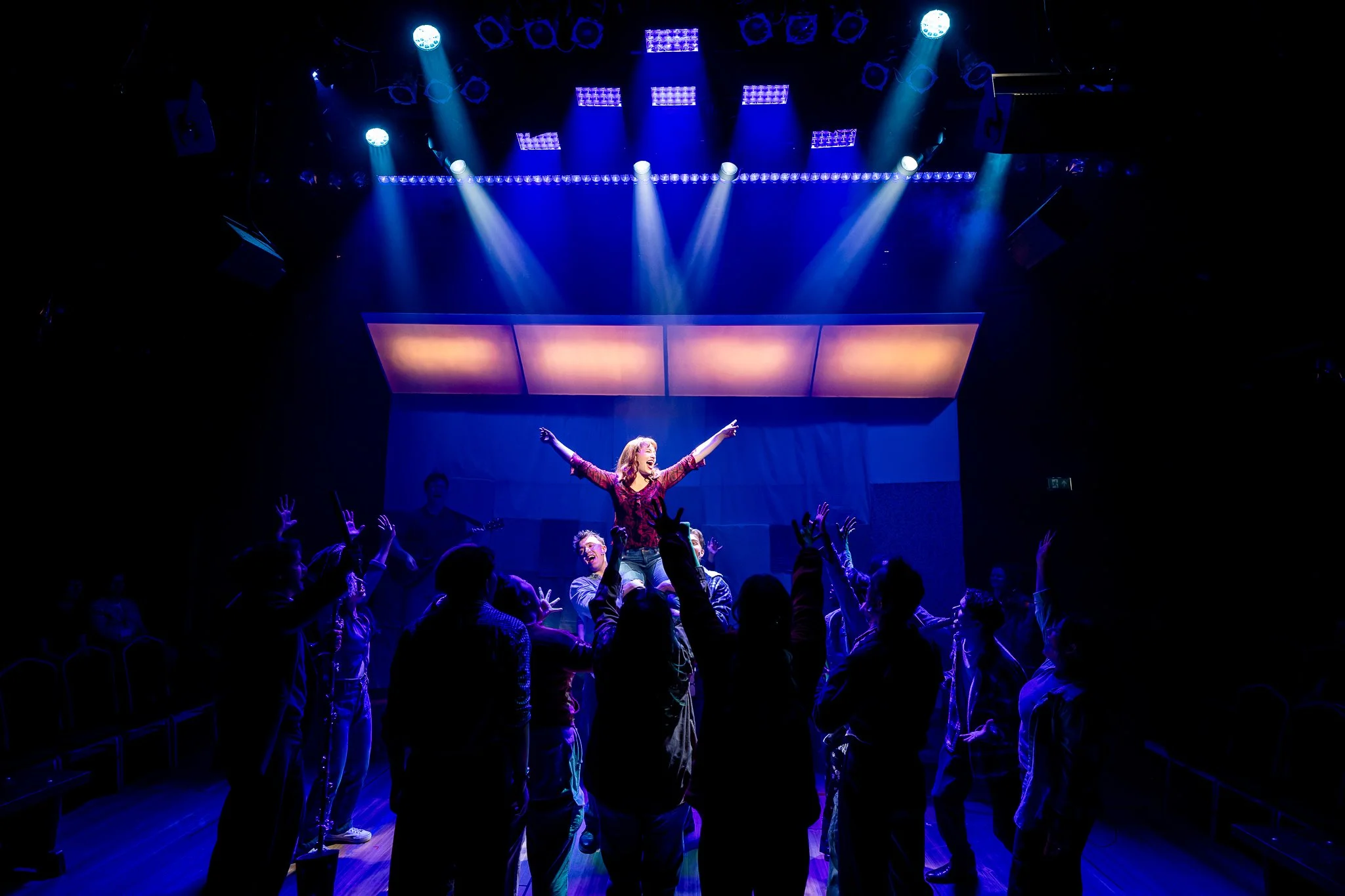
How has my experience as Assistant Director on Come From Away developed my directing practice through the use of realist rehearsal methodologies within musical theatre?
Come From Away occupies a unique position within contemporary musical theatre. Constructed from interviews with the residents of Gander and passengers diverted following the attacks of 11th September 2001, it combines documentary testimony with the heightened conventions of musical theatre. This creates an inherent tension between theatricality and authenticity, raising questions about how truthful performances can be generated within a form that openly embraces stylisation. Working as Assistant Director on the production provided an opportunity to investigate this relationship in practice. This reflection considers how realist rehearsal methodologies, including collaborative dramaturgical enquiry, objective-led actor training and have developed my understanding of directing musical theatre.
Entering rehearsals, I already considered dramaturgical research and objective-led rehearsal fundamental to my approach when directing straight plays. My assumption, however, was that musical theatre demanded a different balance of priorities, with music, choreography and technical precision taking precedence over the sustained realist methodologies that often underpin plays. Working on Come From Away challenged this perception. Rather than sitting alongside the rehearsal process, research became the rehearsal process. As Stella Adler argues, realism is not simply a dramatic style but "a technique, a craft" (Adler, 2000, p.238), and it became increasingly apparent that this technique was no less essential within musical theatre than within naturalistic drama. Instead, the production demonstrated that psychologically truthful performance could only emerge when collaborative inquiry, objective-led rehearsal and rigorous attention to given circumstances formed the foundation of the work.
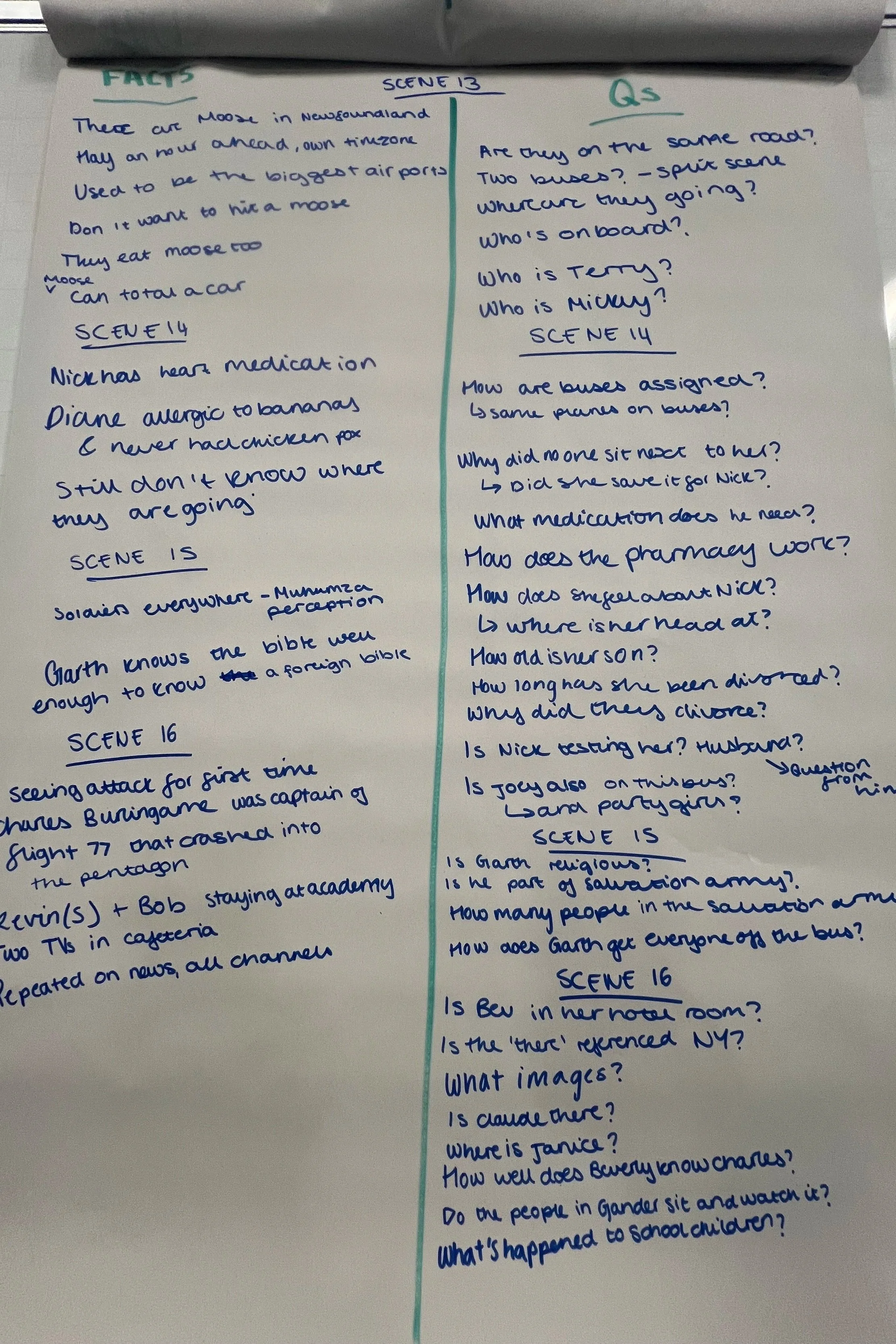
To construct this shared understanding, I facilitated Katie Mitchell's (2009) Facts and Questions exercise during the opening rehearsals. Rather than inviting performers to make immediate interpretations, the company collectively distinguished documented fact from assumption, identifying what could be evidenced within the text and wider historical record alongside the questions that remained unresolved. Running the exercise collaboratively deliberately resisted the temptation to provide definitive answers. Instead, the rehearsal room became a space of shared questioning, encouraging performers to interrogate the material, challenge one another's assumptions and build a collective understanding of the world they were representing. I was particularly struck by how quickly the actors shifted from seeking confirmation from the directing team to generating and testing their own ideas against the available evidence. This demonstrated that the value of the exercise lay not simply in establishing factual accuracy, but in fostering a rehearsal culture where discovery emerged through investigation rather than instruction.
Reflecting on this process challenged my own understanding of the director's role within rehearsal. Rather than positioning myself as the primary source of knowledge, I found that facilitating enquiry generated richer dramaturgical discussion and ultimately more considered creative choices. The rehearsal room became less about providing solutions and more about creating the conditions in which performers could arrive at those solutions themselves. I began to recognise that directing meaningful performance is not simply a process of transmitting information but of carefully structuring opportunities for collaborative discovery. This became one of the most significant developments in my practice throughout the rehearsal process and informed the way subsequent exercises, including the collaborative timeline, were introduced to the company.
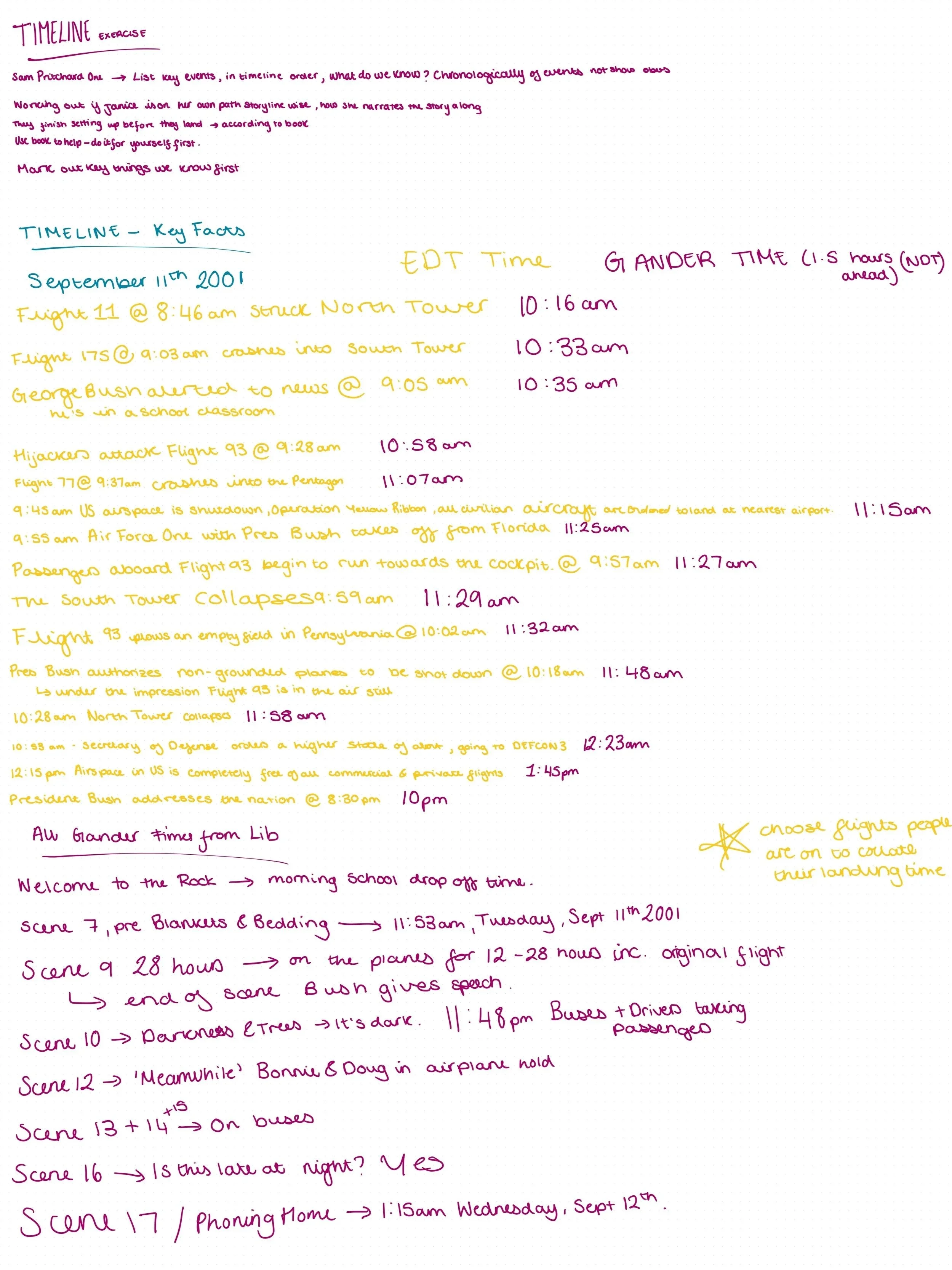
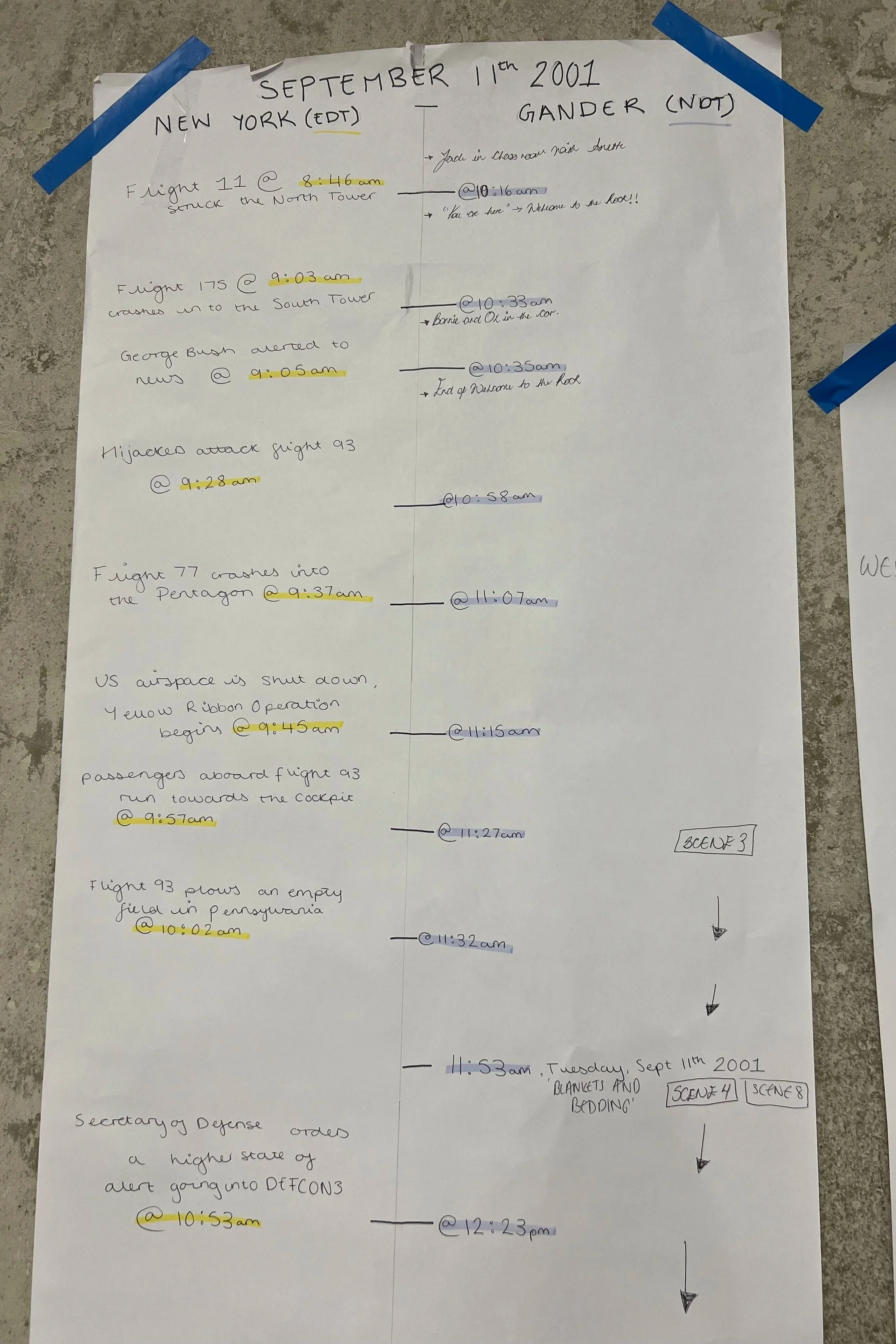
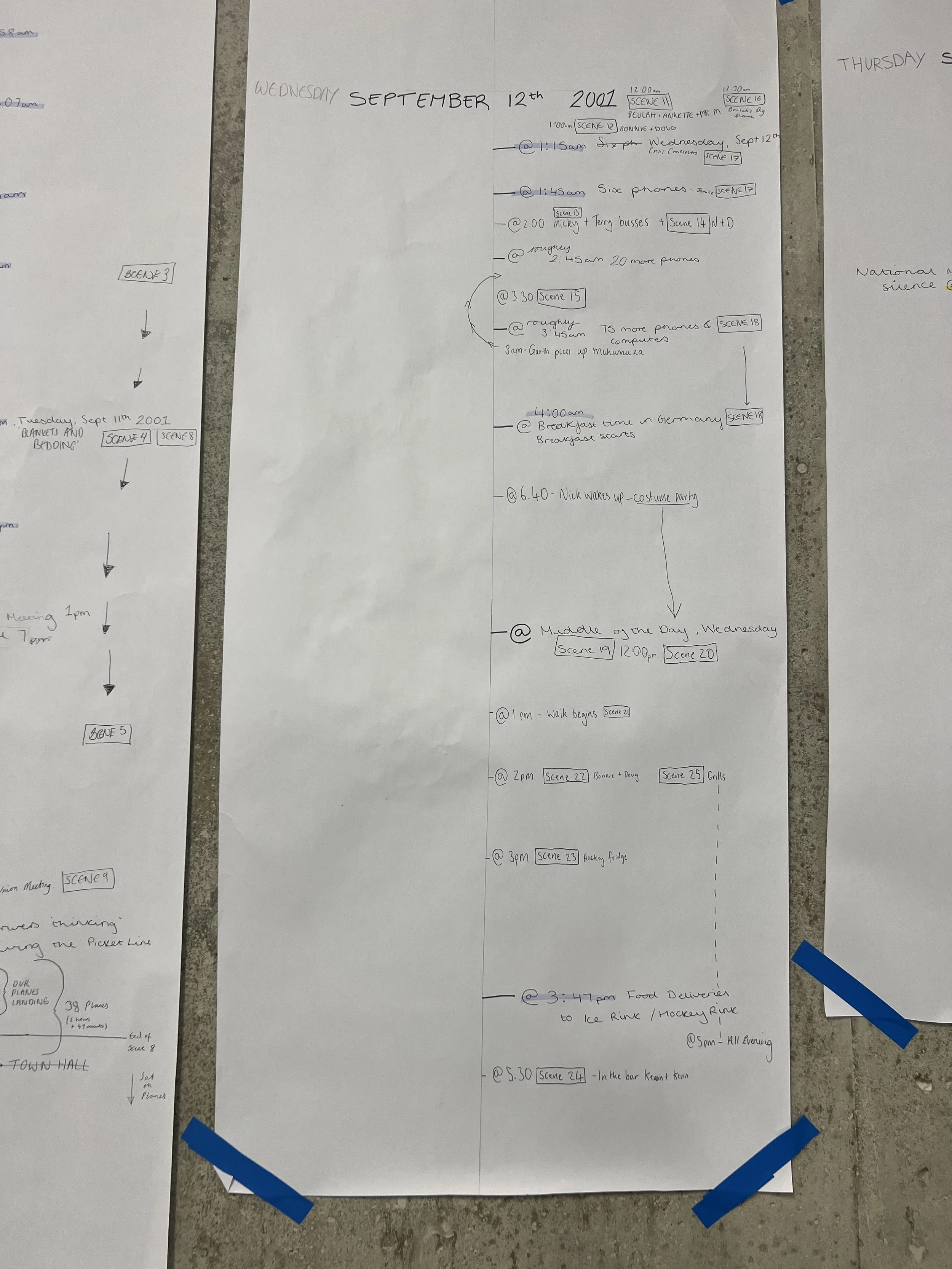
The lines of enquiry generated through Facts and Questions naturally developed into the construction of a timeline. Drawing upon my research from Come From Away: Welcome to the Rock, I prepared both a detailed chronology for rehearsal planning and a blank version that the company completed collectively. Rather than presenting historical research as fixed information, the exercise invited performers to reconstruct the events of the week together, continually testing emerging ideas against documented evidence. This transformed the timeline from a reference document into a practical rehearsal methodology, allowing research to remain an active part of the creative process.
What became increasingly apparent was that the timeline functioned as far more than a chronological record. Initially, I viewed it as a tool for clarifying the musical's complex structure, particularly as the narrative continually shifts between Gander and New York. However, rehearsals revealed that chronology directly shaped behaviour. By establishing precisely what each character knew at any given moment, performers were able to make increasingly specific decisions about their objectives, relationships and responses. This informed practical questions, such as identifying which aircraft individual characters had travelled on, understanding when scenes interrupted or resumed the timeline, and tracing independent journeys such as Janice's development as a young reporter. Rather than simply organising historical information, the timeline became a behavioural framework through which an informed performance could emerge. I began to recognise that chronology was not supporting rehearsal; it was actively generating it.
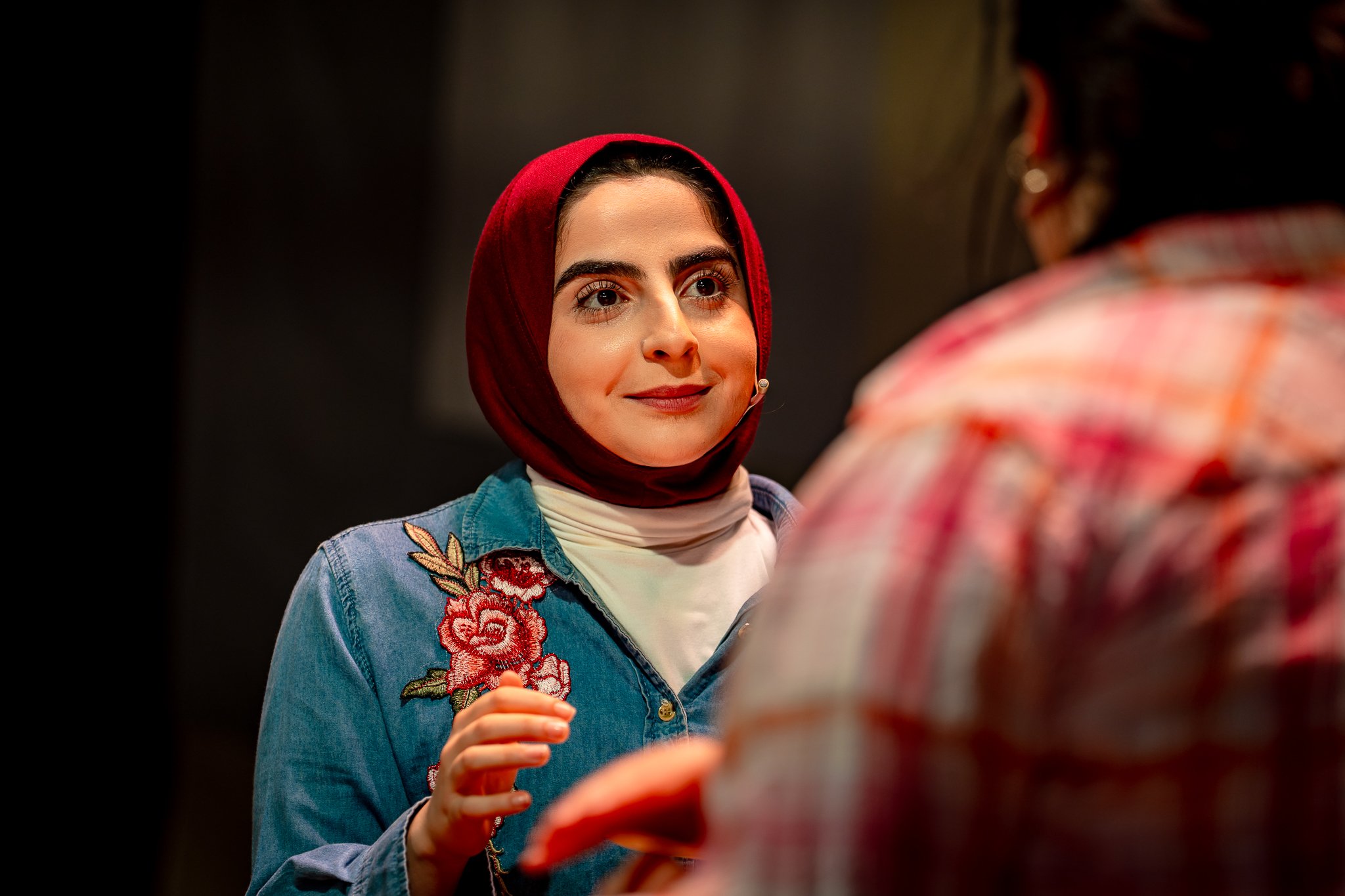
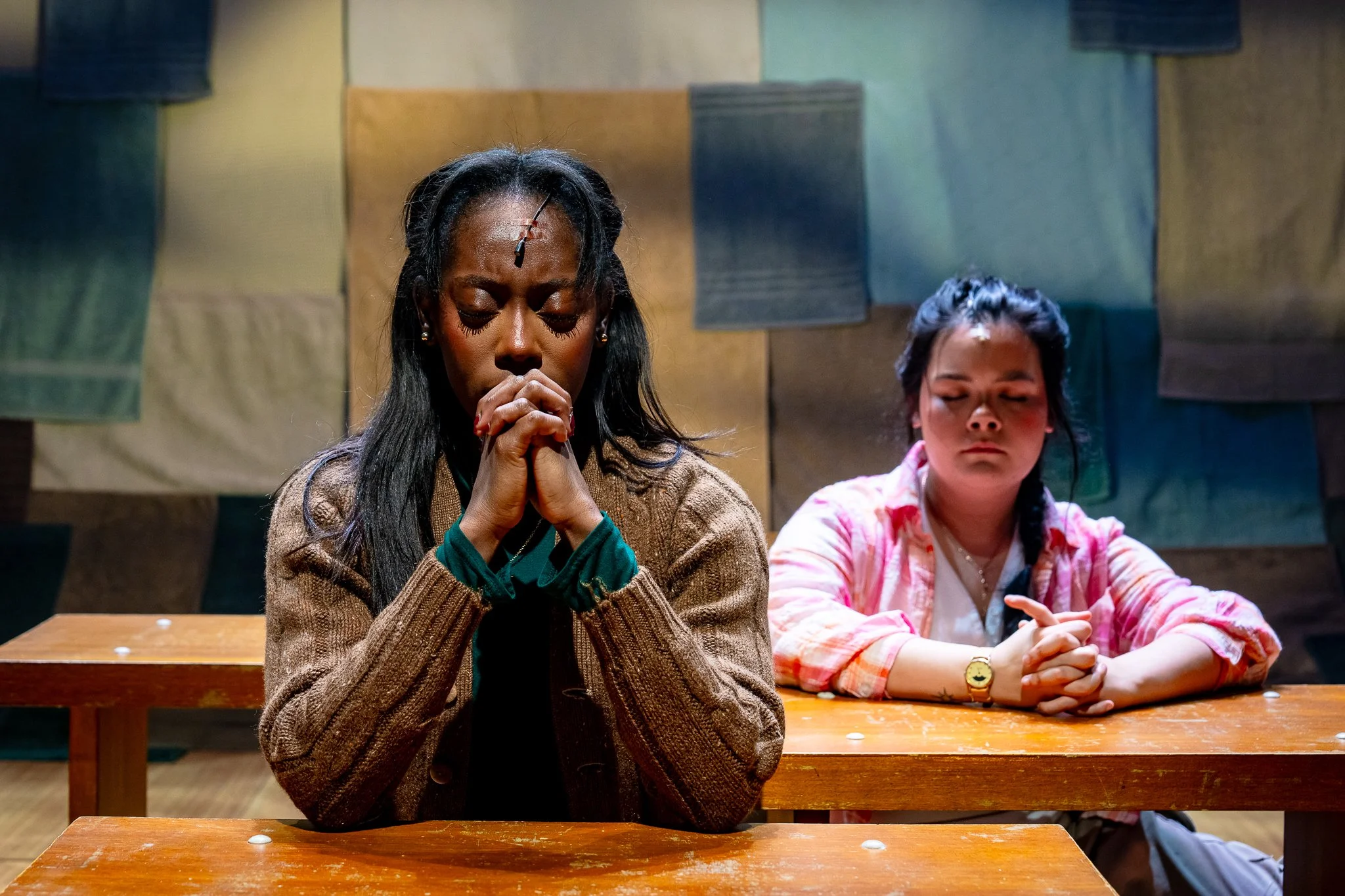
One of the most significant moments for me as an assistant director emerged through my work with Sara, who portrayed Aliyah, a reimagining of the original Broadway character, Ali. While the adaptation initially appeared to require relatively straightforward textual changes, rehearsals quickly revealed a far more complex dramaturgical challenge. Repositioning the character as a Muslim woman fundamentally altered the social and political context through which her experiences would be understood. Rather than simply asking whether the dialogue remained accurate, our discussions focused on how gender, faith and the heightened Islamophobia that followed the attacks of 11th September might shape Aliyah's lived experience. Returning continually to the collaborative principles I established through Facts and Questions, we resisted making assumptions where evidence was limited, instead distinguishing between what could be supported through research and where careful interpretation was required. This process demonstrated that truthful representation extends beyond factual accuracy. It requires sustained critical engagement with the ethical implications of representation. I found that my role was not to provide definitive answers, but to facilitate a process through which historical evidence, the text and Sara's own critical engagement with the material could inform creative decision-making together. Rather than treating dramaturgical research as a means of validating performance choices, I began to recognise it as an ethical framework through which performers can responsibly negotiate identity, representation and lived experience. This significantly expanded my understanding of realism within musical theatre, revealing that authenticity is achieved not simply through fidelity to historical events, but through rigorous consideration of how those events are embodied by the people who lived through them.
Having established given circumstances through collaborative research, my focus shifted to how those circumstances were translated into performance. Objective-led rehearsal was already central to my understanding of Stanislavskian practice; however, working as Assistant Director on this show revealed that its value lies not simply in identifying objectives, but in recognising when rehearsal must continually return to them. Observing actors move between objective-led action and emotionally illustrative performance exposed the consequences of each approach. Rather than sustaining psychological truth, performances became less specific when actors attempted to communicate the emotion. Returning to playable objectives consistently restored clarity, responsiveness and truthful behaviour. This shifted my understanding of objective work from a preparatory analytical exercise to an ongoing rehearsal methodology through which authentic performance is continually refined.
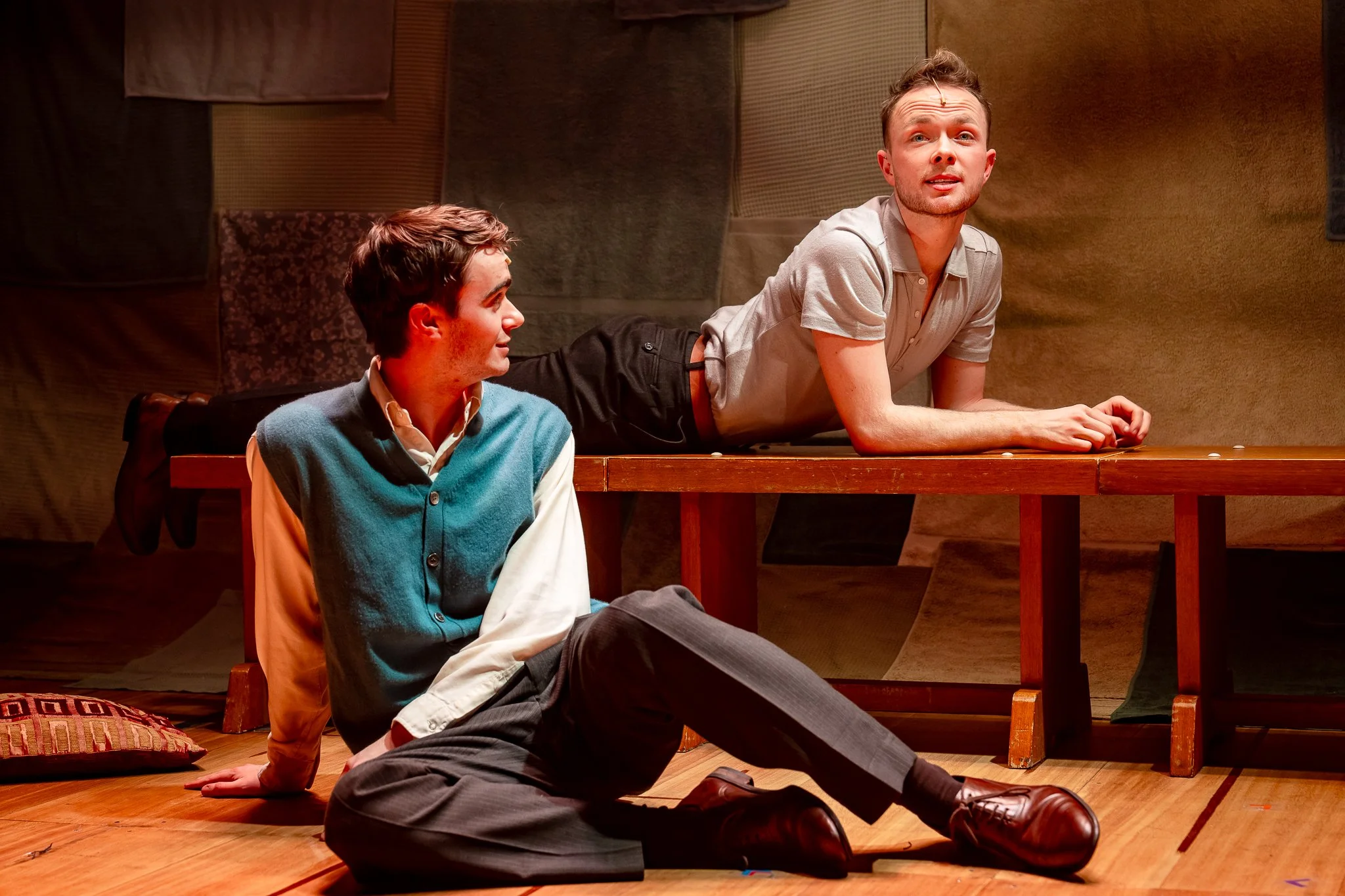
This became particularly evident through the structure of our production and my work with Seb Smallwood and Joshua Conboy, who portrayed Kevin T and Kevin J. While the original Broadway production relies upon twelve performers undertaking extensive multi-roling, our company of twenty allowed greater continuity within individual character journeys without compromising the production's theatrical language. Rather than negotiating constant character transitions, Seb and Joshua were able to sustain and develop the evolving relationship between the two Kevins across the narrative. We focussed on Event work to map across their relationship, identifying how each shift in circumstance altered their objectives towards one another. During rehearsals, I observed both actors occasionally gravitating towards communicating the emotional weight of the scene, particularly in moments of heightened vulnerability. Working closely with them, I continually redirected our discussions towards playable objectives, asking not how the characters felt, but what each Kevin was trying to achieve from the other in that particular moment. As their objectives became sharper and more specific, the emotional complexity of the relationship emerged more naturally through action. Experiencing this process in rehearsal gave practical significance to Mike Alfreds' argument in Different Every Night that actors should pursue playable actions rather than attempt to recreate emotional states. More importantly, it developed my own ability to recognise when rehearsal needed to return to objective work, reminding me that truthful behaviour is sustained not through emotional demonstration but through continually responding to changing circumstances.
My final learning focuses on how that truth could be sustained within the overt theatricality of the show. As Taylor (2012) argues, the conventions of musical theatre simultaneously foreground the genre's departure from realism whilst continuing to "signify itself as realistic" (p.6). Similarly, Wolf (2011, p.165) suggests that musical theatre nevertheless "presumes mimesis", inviting audiences to invest in worlds that are openly theatrical. Working on Come From Away allowed me to investigate this paradox in practice. Rather than attempting to disguise theatrical convention, the rehearsal process demonstrated that authenticity was generated through the performers' continued commitment to objectives, relationships and changing circumstances. Truth did not reside in the physical world created on stage, but in the quality of the human behaviour taking place within it.
This became particularly apparent through the production's staging. Benches continually transformed into aeroplanes, buses, bars and community halls in full view of the audience, while performers remained visible as they moved between locations and multiple characters. The theatrical mechanics of the production were never concealed; instead, it became an integral part of the storytelling. Consequently, actors could not rely upon scenery, uninterrupted environments or sustained character to create an illusion of reality. The audiences were never asked to believe that a bench had become an aircraft, but that the people sitting upon it were experiencing that journey. The more visible the theatrical mechanics became, the more essential it was that performers remained grounded in their objectives and given circumstances. Rather than competing with realism, the production's theatricality depended upon it. Recognising this also reshaped my understanding of multi-rolling. Initially, I associated successful multi-rolling with technical precision and the ability to differentiate characters quickly through changes in physicality, voice or costume. Rehearsals revealed that these external transformations only became convincing when accompanied by an equally rapid shift in behavioural intention. Each transition demanded that performers establish a new set of objectives and relationships within moments, enabling every character to exist as a psychologically coherent individual despite the speed of the shift. I believe what sustained the audience's belief was not the external change, but the actor's immediate commitment to a new reality. I therefore came to understand that successful multi-rolling is less a technical exercise than a behavioural one.
This ultimately reshaped my understanding of a director's role within a highly theatrical form. The collaborative research, objective work and historical investigation established earlier could not remain isolated exercises. There became continual reinforcement as staging developed and theatrical conventions became increasingly complex. Every transition, scene change and spatial adjustment had the potential either to strengthen or weaken the “truth” established in rehearsal. I found myself paying increasing attention to moments where theatrical mechanics risked overtaking dramatic intention, recognising that my responsibility was to ensure it remained anchored in the performers' objectives and relationships. Come From Away therefore demonstrated that realism within musical theatre is not achieved by concealing theatricality, but by cultivating truthful human behaviour capable of sustaining it. This became the most significant insight of the rehearsal process, fundamentally reframing how I understand the relationship between realism and musical theatre within my own directing practice.
This show has demonstrated that realist rehearsal methods are not diminished by the conventions of musical theatre, but are crucial to creating authentic human behaviour within it. Working on Come From Away, I have enhanced my understanding of collaborative dramaturgical research, objective-led rehearsal and continual attention to changing circumstances, even within a highly stylised theatrical form. Most significantly, this experience has refined my understanding of how a director may view realism in musical theatre. Not as an aesthetic outcome, but recognising it as a rehearsal methodology that must be continually nurtured throughout the creative process. This has become a significant development in my own practice and will continue to inform how I approach directing musical theatre in the future.
WORD COUNT - 2011
References
Adler, S. (2000) Stella Adler: the art of acting. New York, NY: Applause Books.
Mitchell, K. (2009) The Director's Craft: a handbook for the theatre. Abingdon: Routledge.
Taylor, M. (2012) Musical Theatre, Realism and Entertainment. Surrey: Ashgate Publishing.
Wolf, S. (2011) Changed for Good: a feminist history of the Broadway musical. Oxford and New York: Oxford University Press.