How has my approach to directing developed over this year?
Through the course of this year I have come to realise that my approach to directing has developed not by adopting a singular aesthetic, but through refining a rehearsal practice that encapsulates my values. I am interested in making theatre that asks better questions of audiences, rather than constantly striving to provide answers. I am drawn to stories that invite curiosity and conversation, while shifting our perspective on classic tales and amplifying unheard voices. As a director I believe that at the crux of this work is creating rehearsal environments where performers can investigate behaviour, challenge assumptions and uncover humanity within art together. Throughout this Masters I have been influenced by the practice of many directors, including Debbie Hannan, Ned Bennett, Sam Pritchard, Carol Harvey and Cressida Carre. Alongside my own research into cultures of care and considered risk-taking. I now believe the rehearsal room as a place where artistic rigour emerges through questioning rather than certainty. This portfolio explores how these experiences have shaped the way I direct and the kind of director I want to become.
Leading with curiosity has become a defining principal of my practice. When coming into this MA I felt like I needed to refine my leadership qualities around certainty, seeing myself next to the larger characters on the course who acted in this manner intimidated me. I felt as if I needed to enter rooms with every question answered, and all artistic decisions already solved. However, my understanding of leadership shifted throughout the year and I realised my strength was in my humility. I believe a director’s authority lies in creating conditions for collective discoveries. For me, curiosity is not the absence of leadership but the foundations for it. This shift was profoundly influenced by our classes with Debbie Hannan, rather than asserting authority Debbie demonstrated how leadership can be exercised through empathy and attentiveness. She encouraged us to enter the rehearsal room not only with a vision, but with an understanding of who we are as collaborators. Her emphasis on bringing your authentic self to a room challenged my thoughts on what I perceived as professionalism, she suggested kindness, tenderness and social awareness are essential to artistic excellence. Debbie’s work made me reconsider how important my own personal sense of self is in a rehearsal room, and to utilise my manner of leading through care as it can create a space that allows performers to engage more fully in creative risk-taking.
Debbie Hannan encouraged us to consider our first introduction to a rehearsal room as an extension of our directorial practice. Rather than beginning with artistic concepts or a detailed vision for the production, she emphasised that the way a director establishes the room is indicative of the rehearsal process that follows. This challenged me to think beyond what I wanted to make and instead consider how I wanted to lead. I strive to be a director who listens, responds, asks questions and shares power with collaborators, recognising that these behaviours communicate far more about my practice than any artistic vision statement. Consequently, I have become increasingly conscious that I introduce myself to collaborators through my actions before my ideas, leading with openness, humility and empathy from the outset of the rehearsal process.
Debbie's approach also foregrounded the importance of acknowledging the lived realities that performers bring into the rehearsal room. As she explains, 'We're going to be in a room where we acknowledge the realities of having bodies' (Waugh, 2023, p.131). Rather than treating accessibility as an additional consideration, this philosophy positions it as a fundamental aspect of collaborative practice. It creates space for performers to articulate what they need on any given day, recognising that physical, emotional and cognitive needs are neither fixed nor uniform. This has significantly shaped my own methodology, reinforcing the belief that creating an environment in which people feel seen and supported is not separate from artistic rigour but enables it. By acknowledging that we are all human, with needs that fluctuate throughout a rehearsal process, I have come to understand care as an active rehearsal practice rather than simply an ethical principle.
Further I feel that my practice has developed through the use of play within a rehearsal room, as directors I think we often want to see a linear progression throughout a rehearsal progress, an idea which is far from accurate for many shows. Throughout my own processes this year I employed a variety of methods of play into my rehearsal process, inspired by the work we did with Ned Bennett. Ned demonstrated to us how we can utilise play as a form of investigation and encourage actors to remain playful, rather than making fixed choices too early. One of the most useful methods of Ned’s work was his Points of Concentration, an idea that encouraged performers to constantly return to their given circumstances through embodied exploration. Rather than allowing scenes to become fixed, the shifting points of focus required actors to actively reengage with objectives, relationships and spatial awareness each time the scene was revisited with a new point of concentration introduced. I found this particularly valuable because it resisted the tendency for rehearsals to become mechanical, instead keeping the work alive through continual rediscovery. Even though on the surface this exercise feels rooted in play, it quickly becomes quite analytical and allows us to encourage instinctual responses, to then later be grounded in certainty. I have adopted a similar outlook in my rehearsal rooms, using play to investigate and generate discoveries that can later be refined. I personally find the elements of creativity within play reduces the over intellectualising of acting, which I can find sometimes obstructs interesting choices being made.
Another technique I have developed into my approach, learnt from Ned Bennett, is his use of Headlines and Perspectives. Rather than encouraging actors to arrive at a single interpretation of a character, they prompt continual reassessment, revealing contradictions, shifting allegiances and hidden motivations. The use of the perspectives exercise allows the actors to embody the character without being attached to scene work. This aligns closely with my own belief that directing should create opportunities for enquiry rather than certainty. I was particularly drawn to how embodied this method was in its use. The investigations often occupied an ambiguous space between dance and conflict, creating movement that resisted categorisation while exposing the changing power dynamics between characters. Rather than illustrating emotion, movement became another form of dramaturgical thinking, allowing relationships to be discovered physically before they were articulated verbally. This has had a lasting influence on my own directing practice, particularly in If the Cap Fits You, where movement emerged through exploratory rehearsal as a means of uncovering behaviour, memory and relationship, rather than serving as decorative choreography. Perhaps most significantly, Ned revisits these exercises throughout the rehearsal process rather than treating them as preliminary exploration. Returning to them after scenes have developed prevents performances from becoming habitual, reminding actors to continually question their choices rather than preserve them. This has influenced the way I now structure rehearsals, recognising that investigation should not conclude once blocking has been established but remain an ongoing process until performance. For me, curiosity is therefore not simply the starting point of rehearsal, but the principle that sustains it.
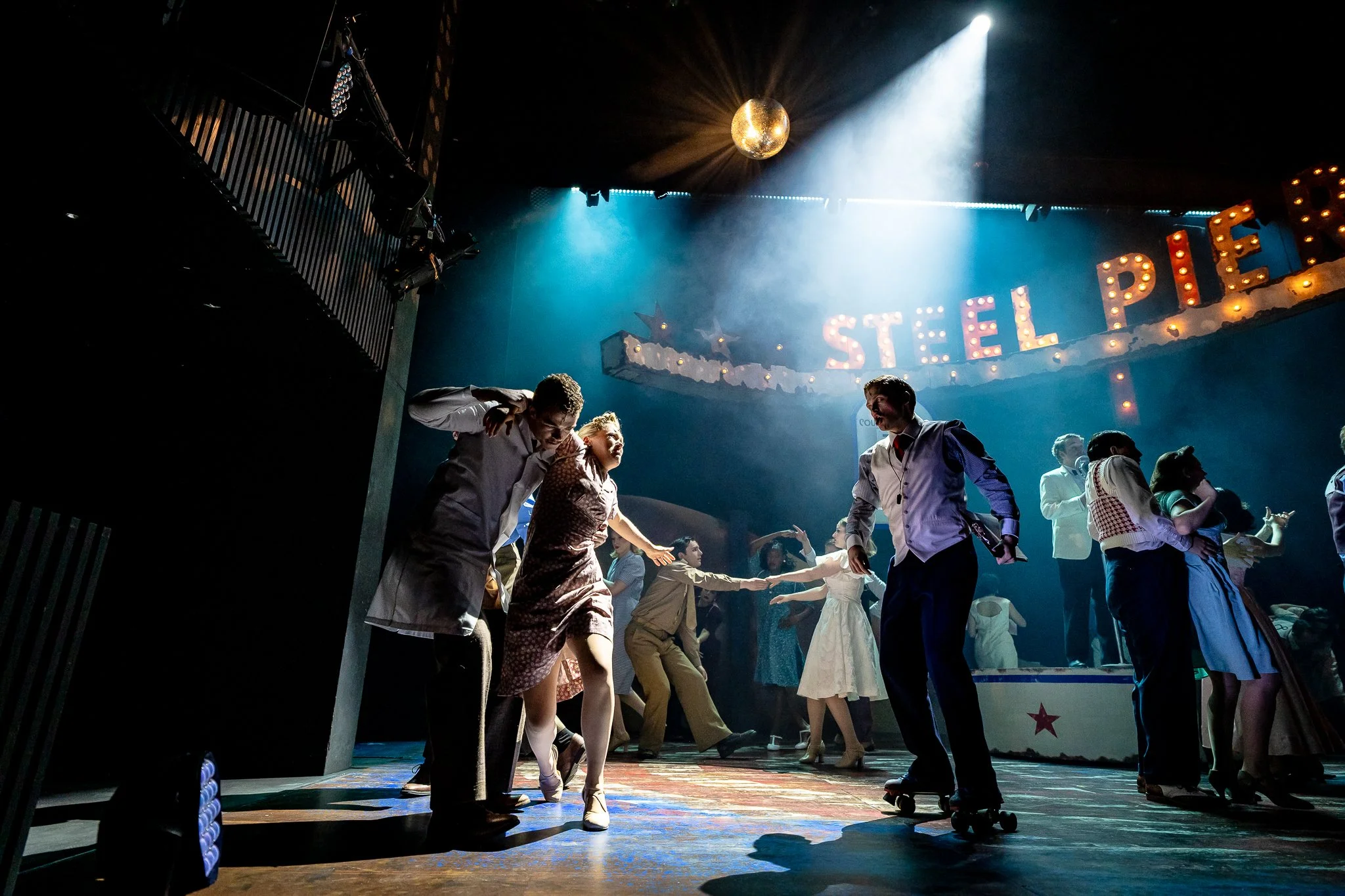
Moreover, throughout the rest of this year I have become increasingly interested in the relationship between dramaturgy and rehearsals. Through my experiences working alongside Cressida Carré and Carol Harvey, I began to understand dramaturgy not as a separate stage of the process, but embedded within rehearsal itself. Working with Cressida on Steel Pier was a vital experience for me to understand how an Assistant Director can benefit the dramaturgy of a piece contributing research that actively informed the artistic development of the production. One of the most significant ways this manifested was through our exploration of the production's recurring Greek chorus moments. Rather than treating these ensemble sequences as transitional devices, we worked to establish them as a collective embodiment of the economic and social pressures surrounding the central narrative. My research into the Great Depression enabled us to interrogate the atmosphere of precarity, aspiration and surveillance that defined the period, allowing these moments to operate as a constant reminder of the world beyond the ballroom. This shifted my understanding of dramaturgy from simply providing historical accuracy towards shaping the thematic language of a production.
Equally influential was our sustained exploration of what it meant for the characters to be seen. Throughout rehearsals we continually returned to the ballroom as both a place of glamour and a site of performance, where individuals were simultaneously seeking recognition and subject to the judgement of others. We explored how characters consciously presented versions of themselves, negotiating visibility, desirability and social status within a public arena. These conversations extended far beyond the dialogue itself, informing the physical relationships between performers, the composition of ensemble moments and the tension that existed beneath the musical's spectacle. Observing how dramaturgical enquiry could influence movement, staging and visual storytelling demonstrated to me that research only becomes meaningful when it is translated into embodied performance. It is this integration of analytical thinking and practical experimentation that I now strive to achieve within my own rehearsal rooms.
This experience naturally deepened my appreciation for Carol Harvey's text-led approach to rehearsal, which further reinforced my belief that dramaturgical discovery begins with rigorous investigation rather than assumption. Carol consistently encouraged us to resist imposing interpretations onto characters, instead asking us to interrogate what the text actually revealed about their behaviour. What particularly resonated with me was Carols's insistence that psychological complexity is constructed through behaviour, not judgement. Rather than asking whether a character was sympathetic or unlikeable, her process continually returned to what they wanted, what they needed, and how those desires shaped the choices they made. I increasingly recognised that truthful performances emerge not through deciding who a character is, but through understanding why they behave as they do. Consequently, my rehearsal process now begins by asking questions of the text before asking questions of performance, allowing analytical rigour to become the foundation upon which embodied exploration can develop.
This year has fundamentally reshaped my understanding of what it means to be a director. Rather than leaving Mountview with an aesthetic or a fixed way of making theatre, I am leaving with a clearly defined methodology rooted in curiosity, collaboration and rigorous enquiry. My practice is no longer driven by a need to provide answers, but by a commitment to asking better questions of texts, performers and audiences alike. I have come to understand that the director's role extends far beyond the creation of performance; it is about cultivating rehearsal environments in which artists feel empowered to challenge assumptions and discover truthful human behaviour together.
As I move into the next stage of my career, I want to continue creating theatre that foregrounds collaboration, amplifies underrepresented voices and invites audiences to reconsider the assumptions they hold about the world and one another. Whether working in new writing, musical theatre or reimagined classics, I want my rehearsal rooms to remain spaces where curiosity is sustained, where care enables creative risk, and where movement, dramaturgy and text exist in continual conversation. While my practice will undoubtedly continue to evolve, I leave Mountview with confidence in the kind of director I am becoming: one who leads with empathy, interrogates with rigour and believes that the most compelling theatre is created not through certainty, but through collective discovery.
Word Count - 1920
Waugh, R. (2023). Running the Room. Nick Hern Books.